
Your Briefings
What You Receive
The findings and actions each level of management needs
Every reporting cycle, Scoop delivers briefings for the locations in scope and the managers responsible for them. A location manager receives practical guidance for their site. Leaders above them receive the patterns and priorities across their part of the business.
Briefings use your terminology for metrics and organizational levels. This guide says "location", "district", and "region"; yours might say restaurant, branch, area, or division. Briefings can also be produced in more than one language.
For the location manager
The location briefing explains the situation at that location and the recommended response. It covers:
| What the manager needs | What the briefing includes |
|---|---|
| An assessment of the location | Its severity rating, main finding, and key figures |
| An explanation of the result | Analysis of the relevant parts of the business, with supporting figures and comparisons |
| A useful visit or team conversation | Specific things to check and questions to ask |
| A plan to act on | Recommended actions, why they matter, their goals, and timeframes |
| A view of what may need attention next | Conditions to watch and, where available, updates on earlier tracked items |
The PDF opens with a one-page summary, followed by the full analysis. Its length follows the findings. Reading Your Briefing explains how to use the sections.
For district and regional managers
The management summary answers a different question: what needs attention across this part of the business?
It identifies the main operating pattern, the status of the units below this level, and the priorities for the manager. It connects shared issues across locations while keeping important local differences visible. The watch list explains which units need closer attention and why.
A district's total may be stable because growth at some locations offsets a problem at others. The summary explains that pattern and directs the manager to the locations behind it. An issue repeated across several locations may need a shared response; an isolated issue may need a focused visit. The local briefings retain the detail for those conversations.
In the portal, managers can move from this summary to individual location briefings. The comparative scorecard, where included, provides a quick view of key measures across the locations on the page. See The Scoop Portal.
Summary PDFs open with a one-page management brief covering the units reviewed, their severity ratings, the operating summary, and management actions. The full analysis follows.
For executive leadership
The executive brief covers the scope agreed for leadership. It brings together the direction of performance, regional differences, and recommended leadership actions. Regional highlights give leaders a way to focus the discussion with the management team.
The emphasis changes with responsibility. Leaders need to understand where a pattern extends across the business and which priorities need management attention. The supporting summaries provide the route back to the districts and locations behind the conclusion.
One finding, different management work
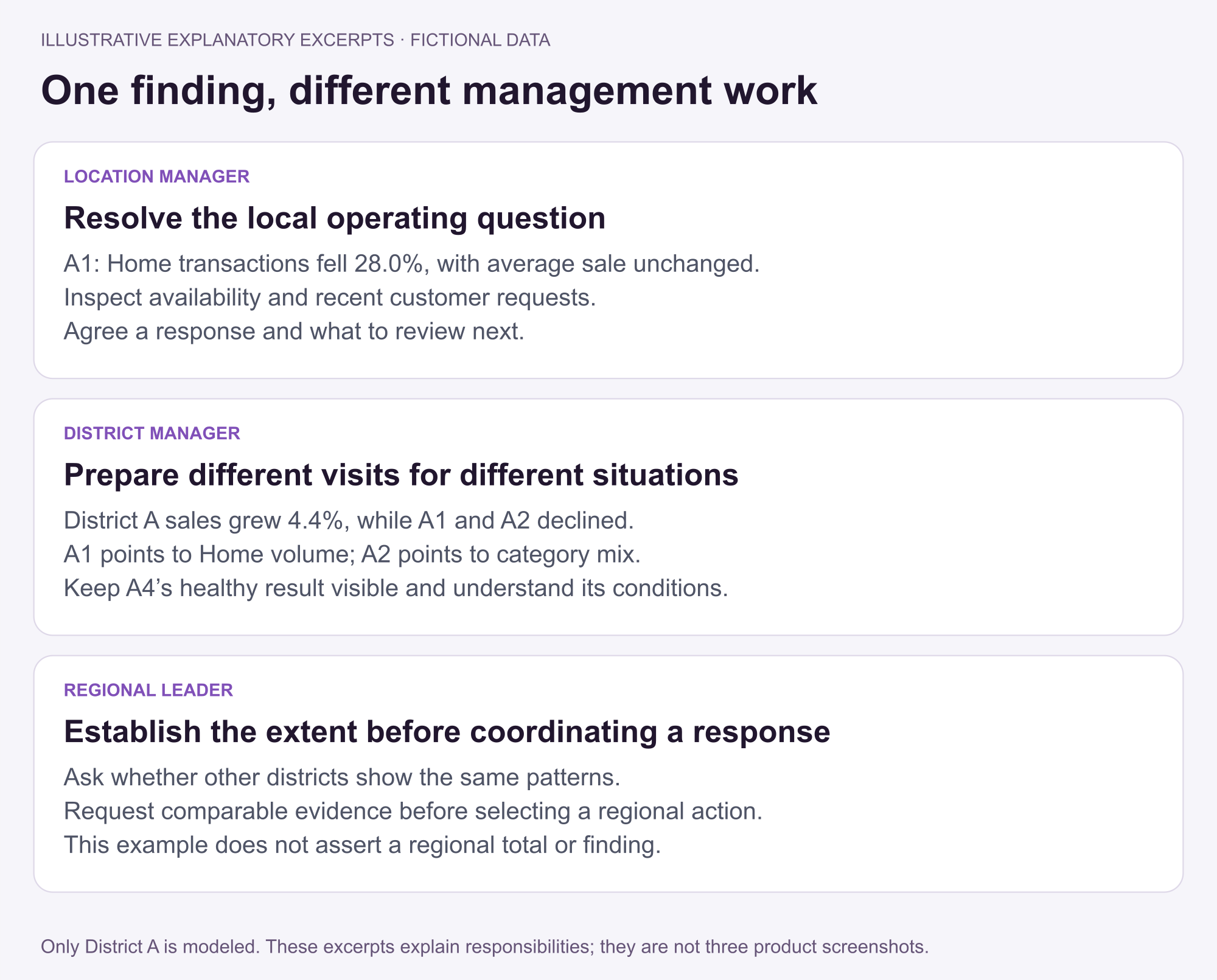
Illustrative explanatory excerpts, not three product screenshots. Only District A's eight stores are modeled; no regional total or wider pattern is asserted.
| Responsibility | Example briefing emphasis | Decision it supports |
|---|---|---|
| Location A1 | Home transactions fell 28.0%, with average sale unchanged | Inspect availability and recent customer requests, then agree a response |
| District A | District growth offsets different problems at A1 and A2 | Prepare different visits; compare findings before coordinating an action |
| Regional leadership | Ask the district manager whether other districts show the same patterns | Request the supporting comparisons before treating this as a regional issue |
| Executive leadership | Review findings across the leadership scope agreed for the engagement | Set management priorities when the supporting summaries establish their extent |
A4's healthy result also belongs in the discussion. Its growth provides a useful question about what is working, while the evidence still needs to establish whether a practice can be extended elsewhere.
Who receives what
| Role | Briefings |
|---|---|
| Location manager | Their location briefing |
| District manager | Their district summary and the briefings for their locations |
| Regional manager | Their regional summary and the summaries for their districts |
| Executives | The executive brief and agreed supporting summaries |
You decide who receives briefings. We maintain the distribution list with you, and access follows each person's agreed part of the business.
Delivery
Our team reviews each cycle's briefings before release and delivers them on the agreed schedule. Every briefing shows its data date and generation date.
PDFs provide a document you can use in management reviews. The portal provides an online reading and action experience, including on a phone. We confirm online access, the available visuals, and action responses during your rollout.
Portal and document formats
The portal offers the current interactive reading experience, including the comparative scorecard, district scatter, trend tiles, and charts where the briefing contains the supporting data. The current scorecard and district scatter are web features. They are not included in the current printed report layout.
PDF and print outputs use their own document composition. A browser's Print view may select particular sections and locations; it is not an export of every portal page. Confirm the document packet included in your rollout. Explore the sample for the portal experience.
Related: The Scoop Portal · Reading Your Briefing · Working with Action Plans