
Scoop Overview
Scoop and Business Intelligence
Compare the work, the output, and who takes responsibility for each reporting cycle
Scoop Analytics adds a managed cycle of performance investigation and management briefings to the data and reporting a business already has. BI platforms and AI analytics tools remain useful for dashboards, exploration, and analysis. The buying decision includes who will establish the operating context, run the recurring review, and deliver something managers can use.
Compare the responsibility as well as the capability
Modern BI and AI analytics tools can identify changes, explain drivers, suggest questions, and support further analysis. For example, Tableau Pulse documents automated insights and guided questions. Capabilities vary by product and setup.
Scoop's service combines your operating playbook, recurring investigation, review by the Scoop team, and delivery of briefings for the management chain. This table describes working arrangements, rather than a feature limit on every tool.
| Work to be done | BI operated by your team | AI-assisted analytics operated by your team | Scoop's managed service |
|---|---|---|---|
| Establish business meaning | Your team defines measures, models, and reporting rules | Your team supplies and governs the context the tool uses | Scoop works with your operators and data owners to establish definitions and the playbook |
| Decide what deserves investigation | Your team designs its review process, thresholds, and dashboards | Your team configures the review or starts an analysis; proactive features vary | Scoop runs the agreed review across the locations in scope each cycle |
| Pursue the next question | An analyst or operator chooses the next comparison using the platform | The user and assistant pursue questions within available data and context | Scoop follows the evidence through questions guided by the operating playbook |
| Prepare material for managers | Your team builds or assembles reports and discussion material | Your team decides how analysis becomes a management deliverable | Scoop delivers findings, evidence, visit questions, and recommendations for agreed audiences |
| Maintain the approach | Your team maintains its reporting and analysis process | Your team maintains context, workflows, and review standards | Scoop maintains the playbook with your team and reviews cycle output before release |
| Decide and act | Your managers | Your managers | Your managers |
A BI partner or internal analytics team can take responsibility for more of this work. Compare the actual service being proposed, including its operating knowledge, output, review process, and ongoing ownership.
Work through the same business question
Suppose district sales grew, but two stores each lost roughly 9%. The manager needs to decide where to visit and what to discuss.
In the fictional Scoop example, A1's transactions fell 10.0% while average sale grew 0.8%. At A2, transactions fell 2.1% and average sale fell 7.5%. A1's loss is concentrated in Home volume; A2's result reflects a shift in category mix.
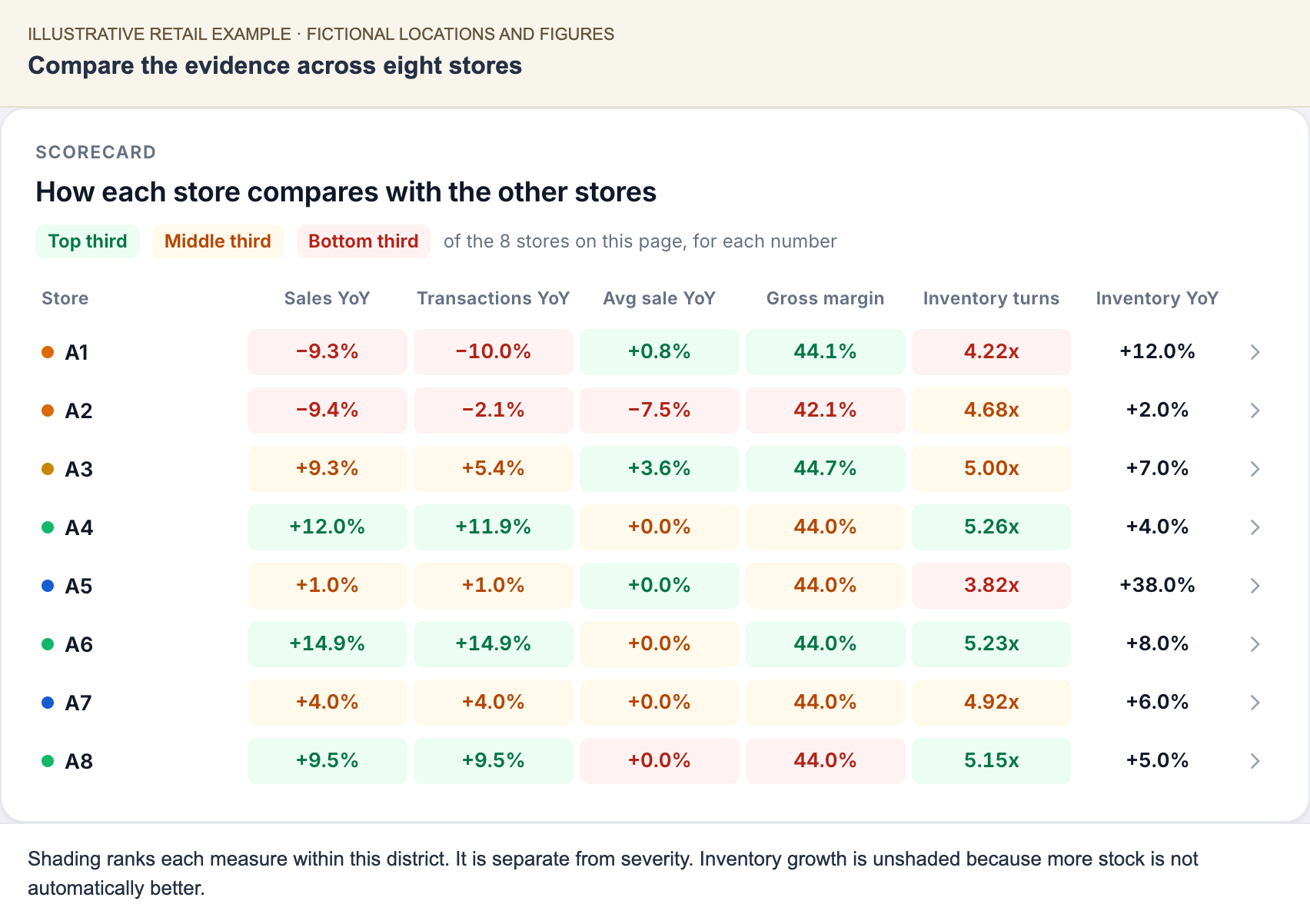
Illustrative figures. Similar sales results lead to different investigative questions and management responses.
A capable analyst can investigate these questions in BI. An AI analytics tool may help find and explain the pattern. Scoop's service takes responsibility for the agreed recurring investigation and prepares the findings for the managers responsible for those locations.
The output is specific: review Home availability at A1; examine the reason for the category mix shift at A2. The supporting evidence and open questions travel with the recommendations. Inside a Scoop Investigation shows the reasoning.
Where Scoop fits well
Scoop is built for businesses with a common operating model across many sites and a management chain that reviews their performance regularly. The service is useful when experienced operators know how to investigate a result, but that approach is difficult to apply consistently across every location and cycle.
Your operators supply the business judgment. Your data owners establish definitions and access. Scoop turns that into the agreed operating playbook, runs the analysis and review, and delivers the briefings.
The playbook includes useful comparisons, questions that test an explanation, operating exceptions, and actions available to each manager.
Where your existing tools remain useful
Keep using BI for dashboards, broad exploration, specialist analysis, and other reporting needs. Your analytics team remains responsible for its data and reporting environment. Scoop works with the agreed data and reporting you already have.
If your main need is a flexible tool for occasional questions or a team that wants to author every analysis itself, a BI or AI analytics tool may be the right fit. Scoop is designed around recurring performance reviews and usable management output.
Scoop needs sufficient data and operating participation. It cannot establish an unobserved cause simply because a metric changed. Managers still validate local conditions, decide on actions, and apply company policy.
What to ask when evaluating the service
Ask to see a complete briefing and the evidence behind one recommendation. Establish who supplies the business context, who maintains it, what each management level receives, how corrections are reviewed, and what happens every cycle. Agree how the pilot will demonstrate usefulness in actual management discussions.
Start with Explore a Scoop Performance Briefing, then Getting Started for the work involved in setting up the service.