

CRM Writeback
Push calculated values back to your CRM automatically
CRM Writeback lets you push calculated values from Scoop back into your CRM system. Blend data from multiple sources, create sophisticated calculations, and automatically update your CRM with the results—enabling enriched customer records without manual data entry.
Why Use CRM Writeback?
| Use Case | Description |
|---|---|
| Customer Health Scores | Calculate scores from multiple data sources, write to CRM |
| Lead Scoring | Combine behavioral data with firmographics for enriched leads |
| Territory Assignment | Calculate optimal territory and update account records |
| Lifecycle Stage | Determine customer lifecycle position from activity data |
| Propensity Scores | Calculate purchase likelihood and push to sales records |
| Data Enrichment | Add external data attributes to CRM records |
How It Works
┌────────────────────────────────────────────────────────────┐
│ 1. EXTRACT                                                  │
│    CRM Data → Scoop Dataset (includes Record ID)           │
├────────────────────────────────────────────────────────────┤
│ 2. ENRICH                                                   │
│    Blend with other data sources                           │
│    Add calculated columns                                   │
│    Create derived metrics                                   │
├────────────────────────────────────────────────────────────┤
│ 3. WRITEBACK                                                │
│    Scoop → CRM (using Record ID)                           │
│    Automatic on each dataset processing                    │
└────────────────────────────────────────────────────────────┘
Supported CRMs
CRM Writeback is available for systems with API connections:
- Salesforce
- HubSpot
- Microsoft Dynamics 365
- Other CRMs with API connectors
See specific application documentation for connector details.
Setting Up CRM Writeback
Prerequisites
Before configuring writeback:
- API Connection — Establish API connection to your CRM
- Record ID — Extract records with their unique CRM Record ID
- Calculated Data — Create the values you want to write back
Step 1: Extract CRM Data with Record ID
When extracting from your CRM, include the Record ID column:
- Salesforce:
Idfield - HubSpot:
record_idor object-specific ID - Dynamics:
accountid,contactid, etc.
Critical: The Record ID is required to update the correct records.
Step 2: Create Calculated Values
Option A: Calculated Columns
- Add formulas directly to your CRM dataset
- Use spreadsheet functions for calculations
- See Adding Calculated Columns
Option B: Blended Dataset
- Combine CRM data with other sources
- Preserve the Record ID through the blend
- Always include Record ID in column selection
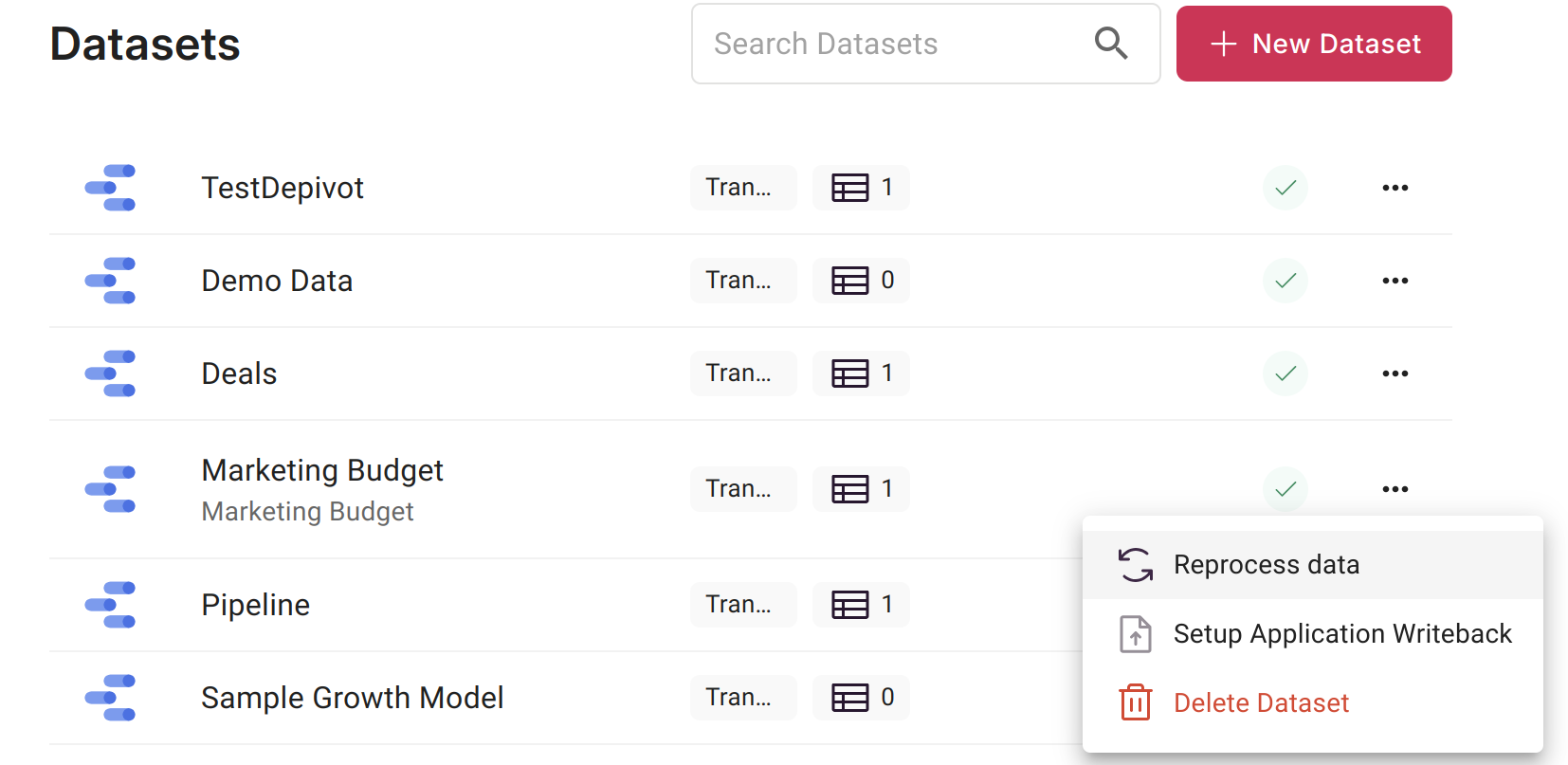
Step 3: Configure Writeback
Once your dataset has calculated values and Record IDs:
- Open the dataset menu
- Select Setup Application Writeback
Step 4: Map Fields
In the writeback configuration:
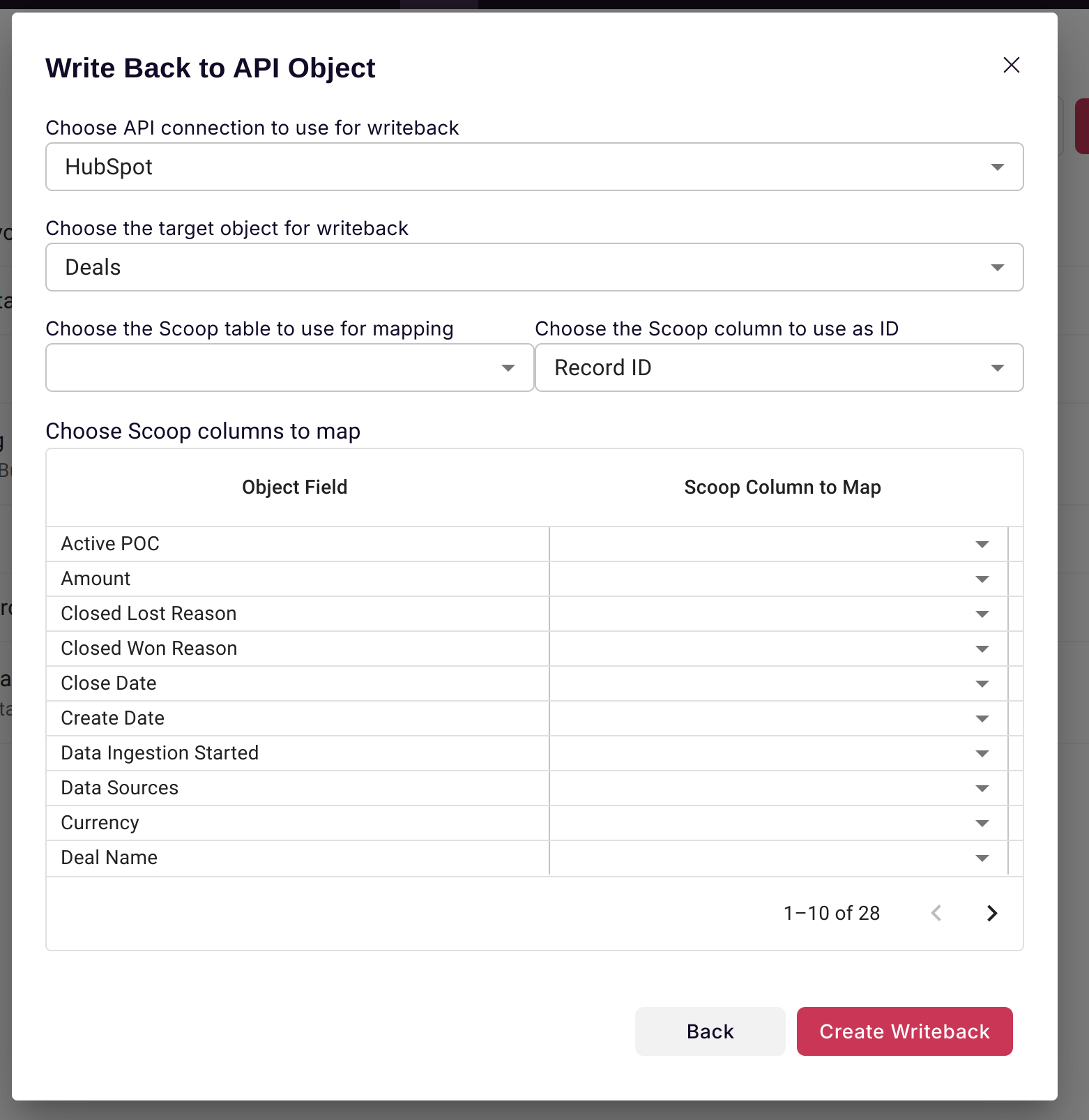
- Select the source table from your dataset
- Map Scoop columns to CRM fields
- Specify which column contains the Record ID
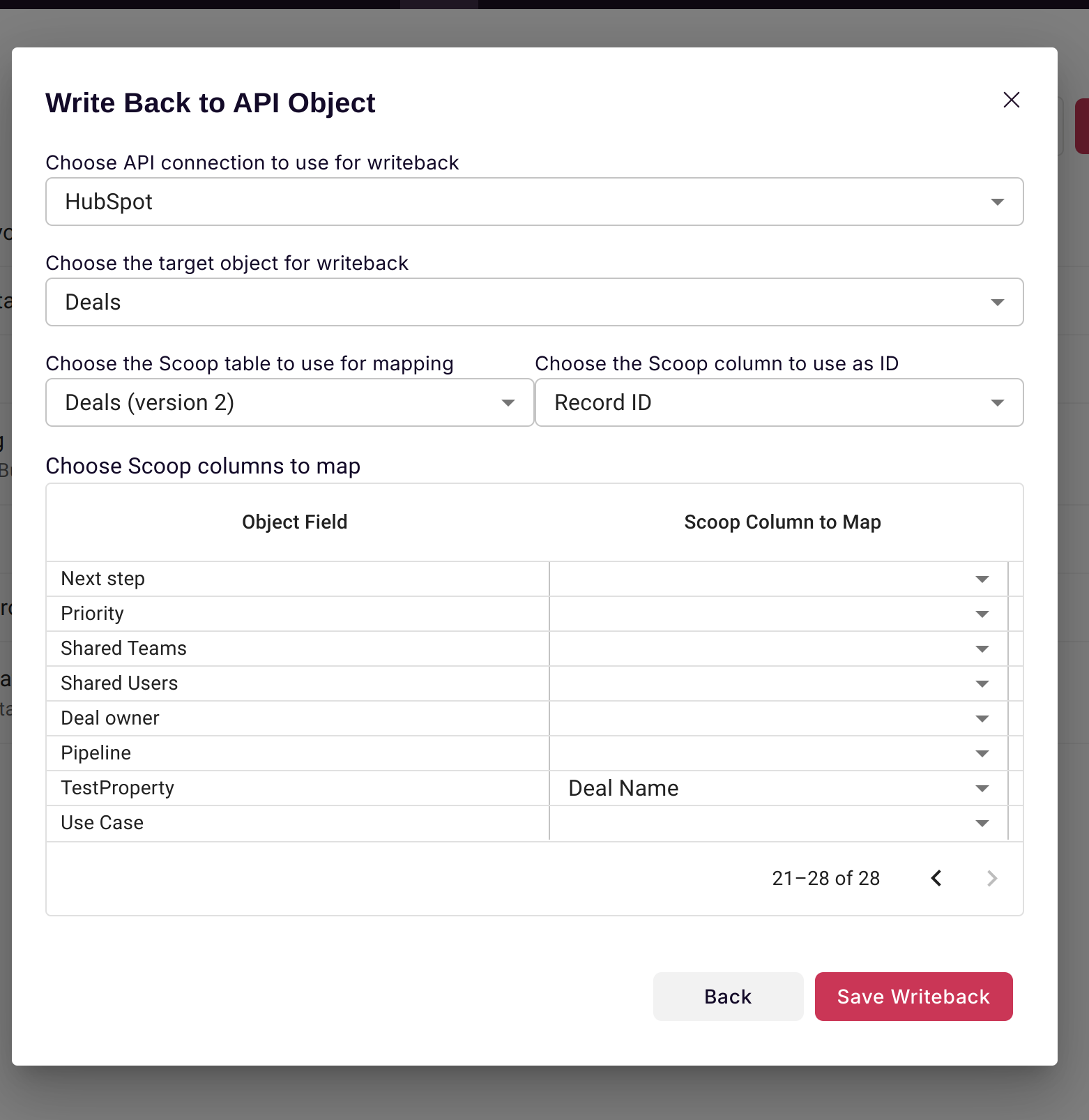
For each CRM field you want to update:
- Select the Scoop column that contains the value
- Verify data types are compatible
Step 5: Activate Writeback
Save your configuration. Now:
- Each time the dataset processes, writeback runs automatically
- Values are pushed to your CRM using the Record IDs
- CRM records update with calculated values
Common Writeback Scenarios
Customer Health Score
Data Sources:
- CRM: Account info, contract value
- Support: Ticket volume, resolution time
- Product: Usage metrics, feature adoption
Calculation:
Health Score = (Usage Score × 0.4) + (Support Score × 0.3) + (Engagement Score × 0.3)Writeback:
- Map
Health_Scorecolumn → CRMCustomer_Health__cfield - Sales team sees scores directly in CRM
Lead Scoring
Data Sources:
- CRM: Lead demographics, company size
- Marketing: Email engagement, website visits
- Third-party: Firmographic enrichment
Calculation:
Lead Score = Demographic Score + Behavioral Score + Fit ScoreWriteback:
- Map
Lead_Score→ CRM lead score field - Marketing automation triggers based on score
Cost to Serve
Data Sources:
- CRM: Account and revenue data
- Support: Tickets and time spent
- Finance: Service costs allocated
Calculation:
Cost to Serve = Total Support Cost / RevenueWriteback:
- Map
Cost_to_Serve→ Account custom field - Account managers see profitability context
Best Practices
Data Quality
- Validate calculations before enabling writeback
- Test with a small subset first
- Monitor for unexpected values
Record ID Handling
- Never modify the Record ID column
- Always include Record ID when blending
- Verify Record IDs match CRM format
Field Mapping
- Match data types (text to text, number to number)
- Consider field length limits
- Check for required field dependencies
Processing Schedule
- Writeback runs each time dataset processes
- Schedule during off-peak hours for large updates
- Monitor CRM API limits
Troubleshooting
Records Not Updating
- Verify Record ID column is correctly mapped
- Check Record IDs exist in the CRM
- Confirm API connection is active
Partial Updates
- Check for null values in Scoop columns
- Verify data type compatibility
- Look for CRM validation rule failures
API Errors
- Check CRM API rate limits
- Verify user permissions for field updates
- Review API connection status
Wrong Values Written
- Review calculation logic
- Check for data type conversions
- Verify correct column is mapped
Monitoring Writeback
Track writeback success:
- Check dataset processing logs
- Monitor CRM field update timestamps
- Verify sample records after processing
Security Considerations
- Writeback uses your established API credentials
- Only fields you map will be updated
- Changes are logged in both Scoop and CRM
- Consider which users can configure writeback
Related Topics
- HubSpot Integration - HubSpot-specific writeback
- Adding Calculated Columns - Create derived values
- Blending Datasets - Combine multiple sources
- Application Connectors - Connect to your CRM
Updated 11 months ago