
Scoop Overview
How Scoop Works
From your business data and operating knowledge to a decision for each manager
Scoop brings together your operating data and the judgment of your experienced operators. It uses both to investigate performance across your business and give each manager a clear account of what needs attention, the evidence behind it, and a practical response.
We first establish how your business should be analyzed. Then, on each reporting cycle, Scoop applies that knowledge to the locations in scope. Our team runs the service, reviews the briefings, and delivers them on the agreed schedule.
flowchart TD
    accTitle: From business knowledge to management briefings
    accDescr: Operating data and the company's playbook guide the review and investigation. Findings, evidence and recommended actions pass through Scoop team review before delivery to managers.
    data["Operating data"] --> investigation["Review and investigate"]
    knowledge["Your operating playbook"] --> investigation
    investigation --> findings["Findings, evidence and actions"]
    findings --> review["Scoop team review"]
    review --> delivery["Briefings for each manager"]
Establish how your business works
A useful investigation needs to know what the figures mean and how your operators make decisions. During onboarding, we capture that knowledge in your operating playbook.
| What we establish | How it shapes the analysis |
|---|---|
| Business definitions | Which measures to calculate, what they count, and how your reporting periods work |
| Business structure | How locations, product groups, and management responsibilities relate to one another |
| Diagnostic judgment | Which patterns matter, what questions to ask next, and which exceptions change the interpretation |
| Available actions | What your operators do in each situation and which decisions belong to each management level |
For example, your operators may know that a steady balance can conceal weakening activity, that a category needs a different performance standard, or that an apparent problem should first be checked against a seasonal pattern. Those distinctions guide the investigation.
We review the initial briefings with your team during the pilot and refine the playbook against real situations. See Your Operating Playbook for what goes into it.
Calculate the evidence from your data
Scoop uses your agreed data sources and metric definitions to calculate the figures the investigation needs. Depending on the engagement, these can include trends, category breakdowns, comparisons with targets, and comparisons among suitable peer locations.
Calculation and interpretation have different jobs. The calculations establish the measured result. The investigation interprets that result in the context of your business and determines what to examine next. AI helps with that investigative reasoning and explanation; the supporting measures are calculated from the data.
The details affect the answer. A count of transactions is different from a count of customers. Sales during a month are different from inventory held on a date. An unfinished month needs a suitable comparison period. We establish these meanings with your team, and the briefing shows the figures and comparisons behind its conclusions.
Scoop uses read-only access or a scheduled extract set up during onboarding. It never writes to your systems.
Review the whole agreed scope
Each cycle starts with a review of the locations in scope. Scoop looks for material changes and patterns across related measures, using the thresholds and comparisons in your playbook.
A review trigger identifies something that merits investigation. A location with falling sales may need a volume and mix investigation. Another may need an inventory review. Locations without that trigger still receive a review of their underlying performance.
This matters when totals look healthy. Growth in one category can offset weakness in another, and a stable balance can coexist with slowing activity. The review looks beneath those headline results.
Let the evidence guide the investigation
The investigation works through the relevant questions in your playbook. Each result helps determine whether to look more closely at a product group, examine a longer history, compare peers, or consider a different explanation.
flowchart TD
    accTitle: How an investigation develops
    accDescr: A relevant question leads to calculations and comparisons. Results are interpreted in business context and may lead to another question. The investigation produces supported findings, open questions and a practical next step.
    question["Ask a relevant question"] --> evidence["Calculate and compare"]
    evidence --> meaning["Interpret in business context"]
    meaning -->|Follow up where needed| question
    meaning --> finding["Findings and open questions"]
    finding --> action["Action or a focused check"]
Consider an illustrative retail situation: sales have fallen in a category. The investigation can separate transaction volume from average sale value, identify the product groups contributing to the change, and examine inventory movement and margin. It can then compare that pattern with earlier periods and peer locations.
Those answers change the management discussion:
- Fewer transactions, with average sale value stable: focus the next check on the lost volume and what happened during customer visits.
- Sales holding up, with margin weakening: examine mix and recent pricing activity in the affected group.
- The same weakness across comparable locations: examine shared conditions and whether the response belongs at district level.
The investigation considers evidence that challenges an explanation as well as evidence supporting it. If the data establishes what changed but leaves the cause open, the briefing identifies a concrete check for the manager. Inside a Scoop Investigation develops this example further.
See the investigative work in a briefing
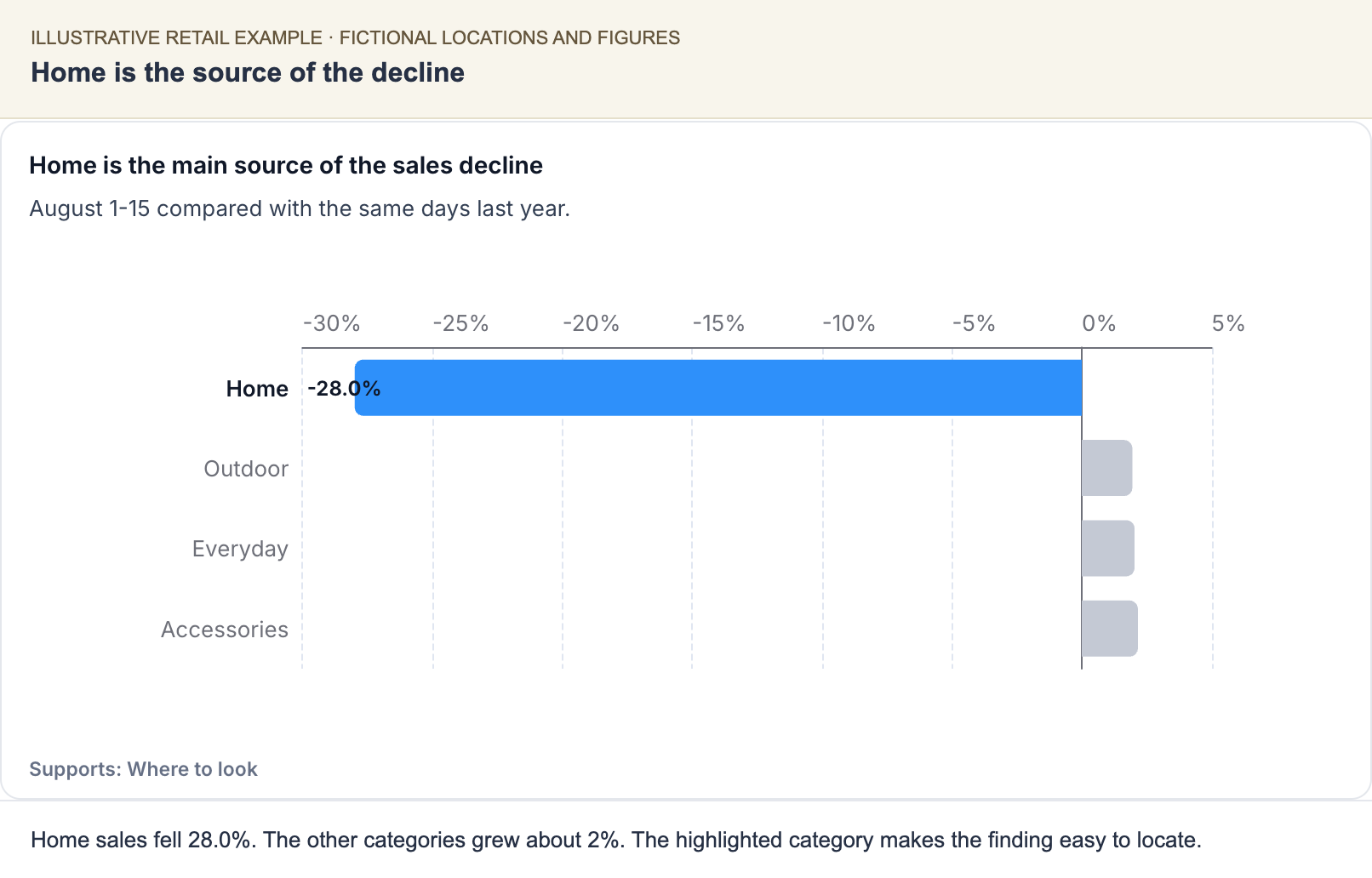
Fictional example: Home sales declined 28.0%, with average sale unchanged. The evidence points to a transaction-volume question.
In the worked investigation, district growth first leads to a location comparison. At A1, separating transactions from average sale directs attention to volume; a category breakdown concentrates the question in Home. Checking the category's unchanged average sale weakens a competing explanation. The briefing then names the operational check that the data cannot settle.
At A2, similar sales weakness leads toward category mix instead. This is why operating knowledge matters throughout the investigation, from the measure's meaning to the next useful question and the manager's response.
Add the context needed to make a decision
Your own history, a peer comparison, and a target answer different questions. Scoop brings those perspectives together where the data supports them. A location may be improving against its own history while still trailing comparable locations; both facts matter when setting the next priority.
Some engagements also include external market information. This can help interpret your own performance or customer mix and identify opportunities worth examining. Sources and scope are agreed during onboarding. Comparisons need to retain their dates and the groups they describe.
The result is an account of the location's situation: the material finding, its supporting evidence, relevant strengths or exceptions, and what remains to be checked.
Match the response to the manager
Scoop assigns a severity rating and recommends actions drawn from your operating playbook. Each plan connects the finding to practical steps, a proposed goal, and a timeframe. A stable location may have a strength to protect or a condition to watch.
Location findings also feed into summaries for the management levels above them. The emphasis changes with responsibility:
| Reader | What the briefing helps them decide |
|---|---|
| Location manager | What to check with the team and which operating actions to take |
| District manager | Where to visit, what to discuss, and which issues are shared across locations |
| Regional or executive leader | Which patterns extend across the business and where broader management attention is needed |
A district total may be stable because some locations are growing while others weaken. The summary explains that pattern and retains the route back to the local findings. It gives the management chain a shared basis for discussion while preserving the differences that matter.
Review, deliver, and follow through
Our team reviews each cycle's briefings before release. Managers receive the findings through the agreed PDF briefings and Scoop portal. In the portal, they can move from the management conclusion and scorecard to a location's evidence, visit questions, and recommended actions.
Managers decide how to respond. Where action responses are enabled, they can accept a recommendation, adjust it, defer it, or reject it with a reason. That response records the decision and local context. Completing an action and achieving its intended result remain separate questions.
Later briefings report prior-item progress when the earlier item and verified progress data are available. Our team also reviews feedback about definitions, interpretations, and recommended actions with you. Agreed changes to the playbook can then guide future cycles.
See Working with Action Plans for response and follow-up details, or Getting Started for the onboarding and pilot process.
Related: What Is Scoop · Your Operating Playbook · What You Receive